
Civil 3D Alignment Spiral Types Explained
- Kate Brown
- Apr 13
- 7 min read

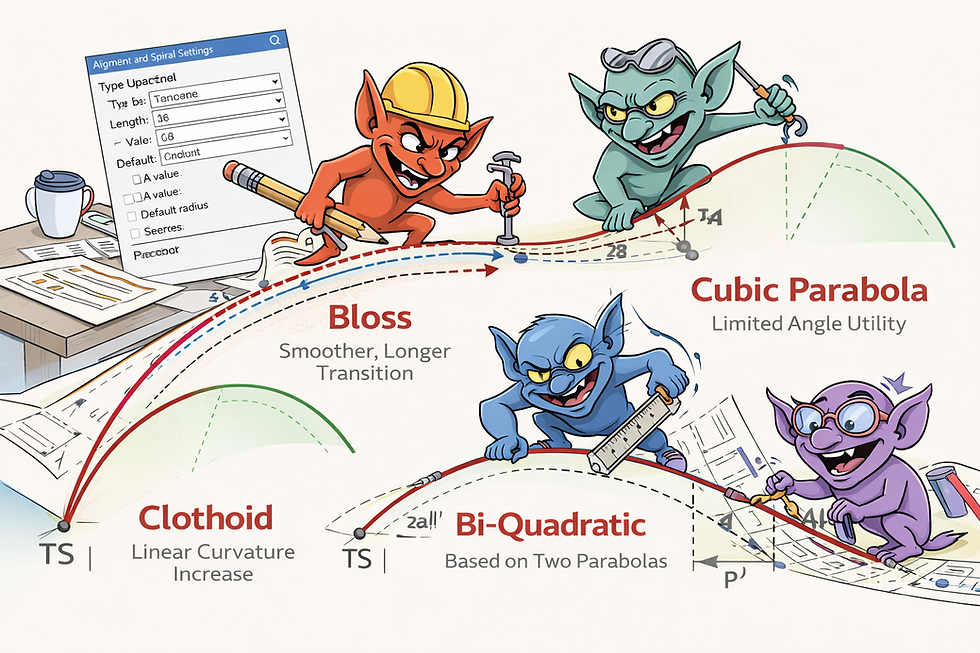
You open the alignment tools expecting to draw a road centerline.
Instead, Civil 3D hands you a spiral type dropdown that reads like somebody lost a bet with a math department:

Clothoid
Bloss
Bi-Quadratic
Cubic Parabola
Cubic (JP)
Sinusoidal
Sine Half-Wavelength
At that point, most people do one of three things:
Pick Clothoid because it sounds vaguely familiar
Pick something else because it sounds smarter
Pick literally anything and hope the design reviewer don't know
Unfortunately, those options are not decorative. They are not there to make the software look sophisticated. They are different transition curve formulas, and they change how the alignment moves from straight tangent into full curve.
So yes, the dropdown matters. Annoying, but true.
What Are these Spiral Types?
All of these options are trying to solve the same problem:
A vehicle, train, or path should not go from dead straight to full curve like it just got startled.
A transition spiral softens that change by gradually introducing curvature. The difference between the spiral types is how that curvature increases along the length of the spiral.
That is the whole game.
They all transition from tangent to curve, but they do it with different mathematical behavior, which means they differ in:
smoothness
shift
extension
dynamic feel
suitability for rail vs roadway
usefulness at low or high deflection angles
whether they are actually standard practice or just lurking in the menu for emotional support
Clothoid: The Default Adult in the Room

If spiral types were coworkers, Clothoid would be the competent one who just gets the job done without needing a dramatic introduction.
A clothoid spiral increases curvature linearly with length. That is why it is the standard answer in a lot of roadway and railway work. It is predictable, widely accepted, and easier to justify when somebody asks why you chose it.
In practical terms, Clothoid is usually the safe pick because:
it behaves in a clean, consistent way
it is widely recognized in design practice
it provides a smooth transition into the circular curve
it is the one most people actually mean when they say “use a spiral”
So if you are staring at the dropdown and wondering which option is least likely to get you roasted in review, Clothoid is usually your friend.
Translation:If you do not have a standard forcing something else, this is often the right answer.
Bloss: The Rail Kid With Better Manners
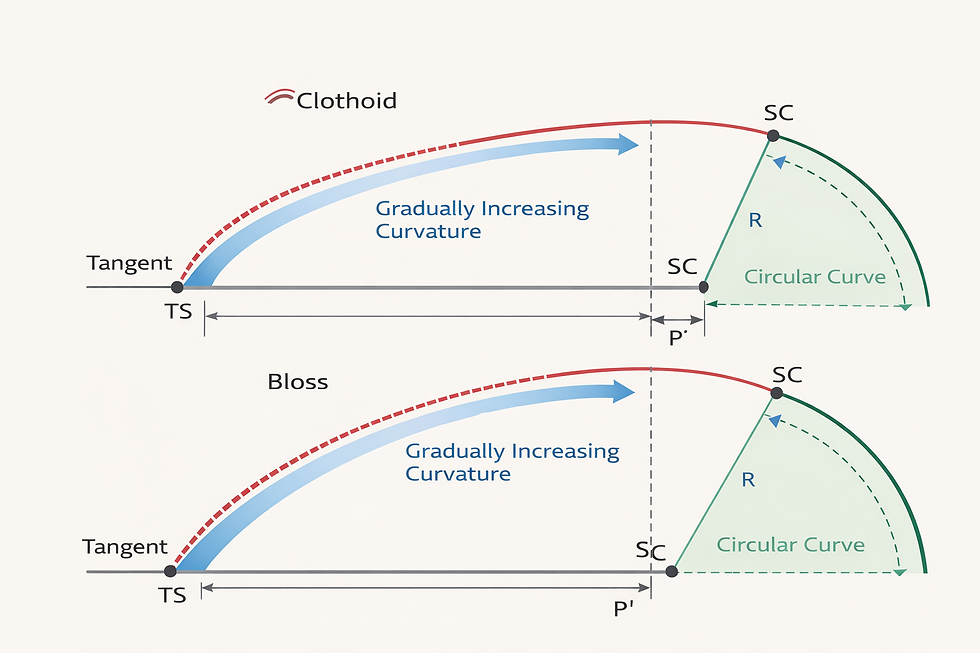
Bloss is another transition spiral, but it differs from the clothoid in how it handles the geometry of the transition, especially things like shift and extension.
In plain English: it is still doing the same basic job, but it has different transition characteristics that can make it attractive for rail design.
Compared with Clothoid, Bloss is often favored where the designer wants:
a longer transition
less shift
smoother dynamic behavior in certain applications
This is where the dropdown stops being “same curve, different brand name” and starts becoming “same purpose, different personality.”
Clothoid is the general-purpose favorite. Bloss is more of a specialized, more refined option where that geometry behavior matters.
Clothoid is the reliable default. Bloss is what shows up when somebody actually cares about true transition theory.
Bi-Quadratic: For When You Want Less Drama in the Ride

Bi-Quadratic sounds like something a cartoon villain uses to launch a laser, but it is basically a transition spiral made from two second-degree parabolas (yes, now we are confused from geometry terms).
Its claim to fame is smoother dynamic behavior, especially where lower acceleration effects matter.
That means Bi-Quadratic gets attention when the concern is not just “does this curve connect?” but also “does this transition behave nicely?”
This makes it useful when ride quality and motion control matter more than just slapping in a serviceable spiral and moving on with your day.
It is not usually the default everyday pick, but it exists for a reason.
Translation: If Clothoid is the standard office sedan, Bi-Quadratic is the same version with upgraded suspension.
Cubic Parabola: Useful, Until It Starts Getting Weird
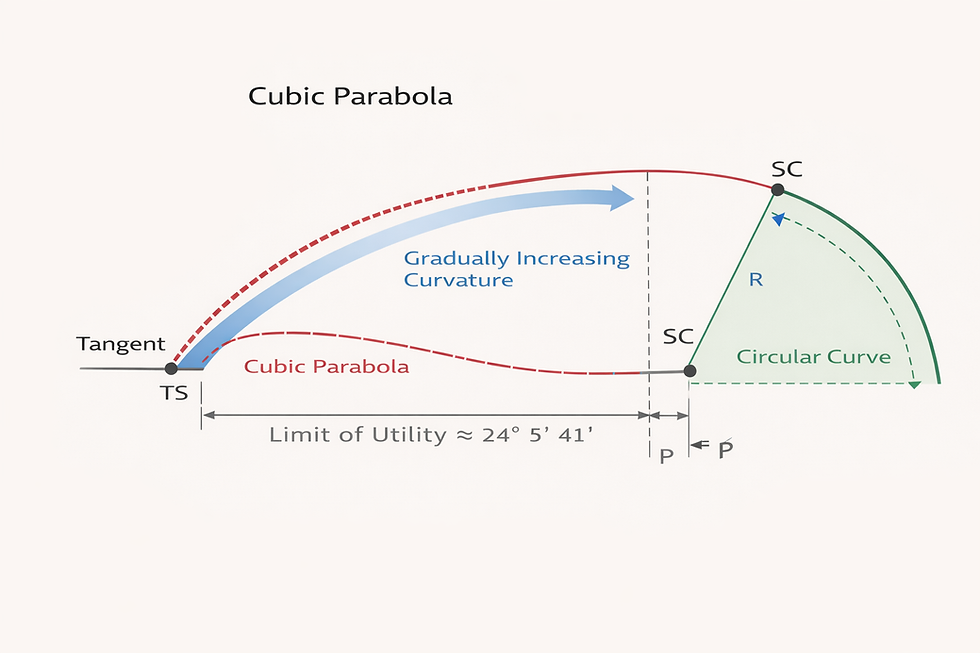
Cubic Parabola is another transition form, and on paper it sounds perfectly respectable. But like a lot of respectable things in geometry, it comes with caveats.
It can work well in certain conditions, but it is not always as broadly useful as a clothoid because its geometric behavior becomes less practical beyond certain deflection ranges. So while it is a real option, it is not necessarily the one you grab first unless your standard, workflow, or regional practice actually calls for it.
This is the kind of spiral that tends to get chosen by people who either:
know exactly why they want it, or
absolutely do not know why they want it and are just clicking with confidence
There is very little middle ground.
Translation: Not fake. Not useless. But definitely not the “sure, just use this everywhere” option.
Cubic (JP): Same Problem, Different Rulebook
Cubic (JP) is not Civil 3D being quirky for fun. It is a regional, standards-driven variation associated with Japanese design practice.
That is an important difference.
This is not just “another cubic because more cubics seemed exotic.” It exists because certain standards and design conventions wanted a different mathematical approximation for transition behavior, particularly for cases like smaller deflection angles or large-radius work.
So unless you are working under that design framework, this usually falls into the category of: “I should probably not pick this just because it sounds technical.”
Translation: Legitimate option, but usually standards-driven rather than general-purpose.
Sinusoidal: Mathy, Valid, and Not Everybody’s Favorite
A Sinusoidal spiral uses a sine-based curvature development. Which is fine. Very elegant. Very mathematical. Very impressive if your goal is to make the dropdown sound like a graduate thesis.
In practical design terms, though, it is less commonly used than clothoid. Not because it is nonsense, but because being mathematically valid and being the most practical field choice are not always the same thing.
Some spiral types exist because they solve a real niche problem. Some exist because the universe of possible transition math is apparently endless and software engineers have no natural predators. (Kidding!)
Sinusoidal is one of those options that tends to make more sense when you are following a specific design method than when you are just trying to build a clean alignment on a Tuesday afternoon.
Translation: Real spiral. Usually not the first one most people reach for.
Sine Half-Wavelength: Specialized and Absolutely Not Casual
Sine Half-Wavelength sounds less like roadway geometry and more like a Rock Band Name, but it is another specialized transition form, commonly associated with Japanese railway applications and lower-angle transition behavior.
This is not the generic everyday roadway spiral. This is the “we have a very specific operating context and standards basis” spiral.
Which is great if that is your project.
Less great if you are picking it because Clothoid felt too mainstream.
Translation: Specialized, rail-ish, regional, not random — but definitely not the default for ordinary alignment work.
So What Is the Actual Difference Between These Spiral Types?
They all create a transition between tangent and curve, but they differ in:
1. How curvature develops
Some increase curvature in a very straightforward way. Others shape that increase differently for smoother dynamic response, different extension behavior, or regional design preferences.
2. How the transition feels
Not all spirals behave the same in motion. Some are chosen because they provide a more refined ride or better vehicle dynamics.
3. How much geometric shift they create
Some spiral forms require different amounts of offset or shift to fit between tangent and circular curve.
4. What kinds of projects they are best suited for
Some are common in roads. Some show up more in rail. Some are tied heavily to particular national or institutional standards.
5. How normal they are in everyday use
This may be the most important difference of all. Some are standard workhorses. Others are niche, specialized, or standard-specific.
That means the dropdown is not a list of equal choices. It is more like a spectrum ranging from:
“widely used standard option”
to
“very specific answer to a very specific geometry problem or regulation requirement”
The Practical Ranking Nobody Puts in the Help Files
Clothoid
The standard, practical, professional choice most people should start with.
Bloss
A more specialized alternative, often appealing in rail or where transition properties matter more deeply.
Bi-Quadratic
A deliberate choice when smooth dynamic behavior is a priority.
Cubic Parabola
Legitimate, but not the universal darling.
Cubic (JP)
Regional and standards-based, not your casual default.
Sinusoidal
Mathematically respectable, less common in ordinary production work.
Sine Half-Wavelength
Specialized enough that you should probably know exactly why you are using it.
What This Means in the Curve and Spiral Settings Box
When you pick one of these spiral types in the alignment settings, you are not choosing a visual style.
You are choosing the mathematical law for the transition.
That affects how the alignment:
enters the curve
exits the curve
distributes curvature
behaves dynamically
fits within the available geometry
So the choice between Clothoid and Bloss is not like choosing the red pill or the blue pill. It is choosing one transition model over another.
Which, naturally, is something the software documentation explains with the warmth and understanding of DIY furniture instructions.
The Best Practice on which to choose?
If you do not have a project standard telling you what to use, the safest question is:
What kind of job is this trying to do?
Need the standard, widely accepted answer? Use Clothoid
Need something more rail-focused or transition-refined? Look at Bloss
Need smoother dynamic behavior? Consider Bi-Quadratic
Working under a specific regional or agency standard? Use what that standard requires and do not freelance your way into a review comment
Because that is the real lesson here:
These are not “creative options.” They are geometry tools with different purposes.
This is not where you express your inner child.
Final Thoughts
The spiral type setting is one of those Civil 3D features that looks harmless until you realize it is quietly asking a serious geometry question.
Clothoid, Bloss, Bi-Quadratic, Cubic, and the others are not duplicate options. They are different ways of controlling how curvature develops through a transition. Some are widely used defaults. Some are specialized tools. Some are strongly tied to rail design or regional practice. And some are sitting in that menu just waiting for someone to misuse them with confidence.
Thanks for stopping by the Den! Civil 3D: It’s not a bug, it’s a feature. Allegedly.


Comments